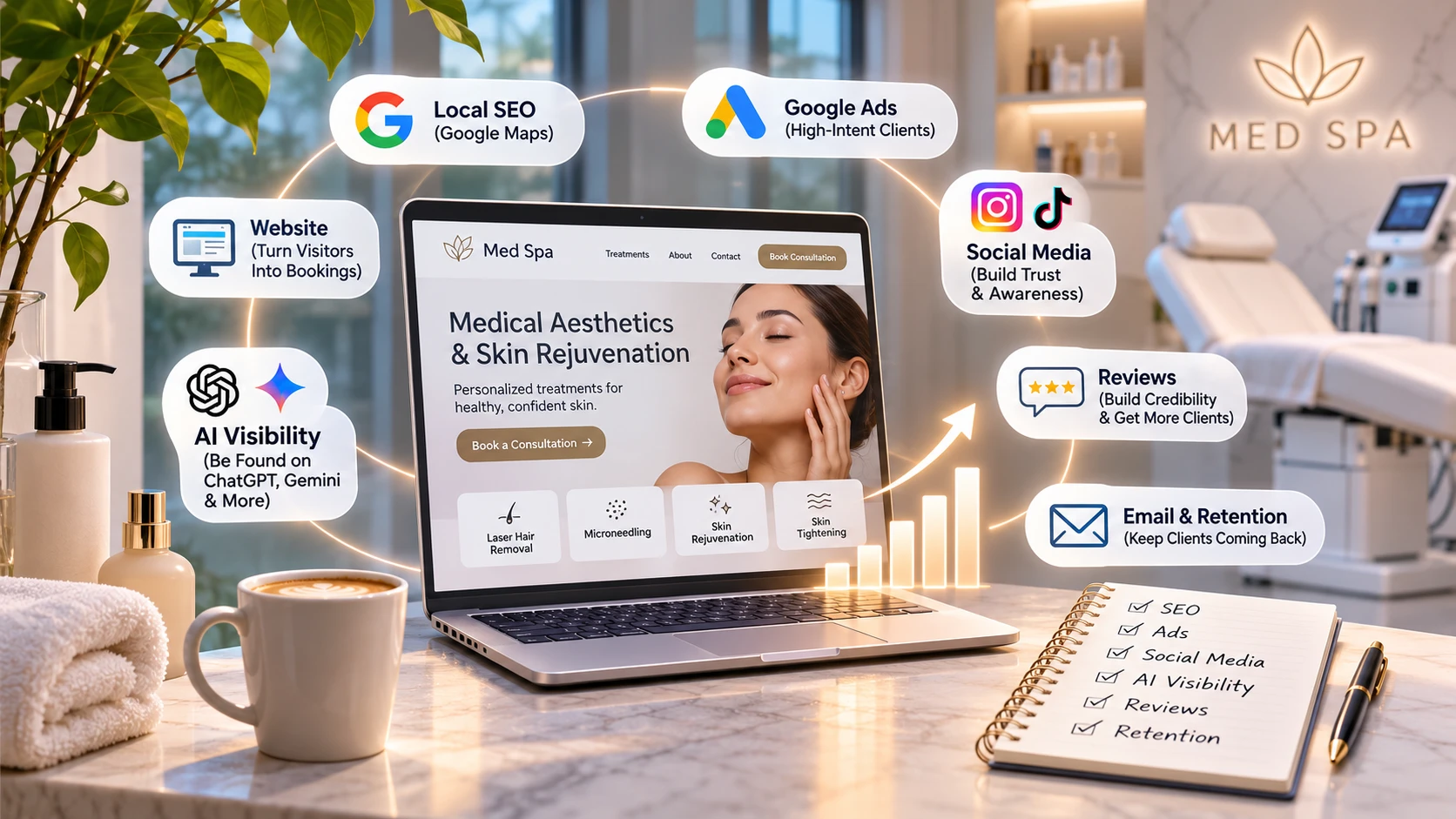
How to grow your medical spa with SEO, Google Ads, social media, AI visibility, and a website that turns visitors into actual bookings.
Running a medical spa is already a full-time job. Between appointments, treatments, managing staff, and keeping clients happy, marketing can easily become something you deal with whenever you have a spare moment.
Maybe you're posting on Instagram but not getting many enquiries. Perhaps you've tried Google Ads and spent hundreds of dollars without a booking. Or maybe you have a beautiful website that nobody seems to find.
If that sounds familiar, you're not alone.
People are discovering medical spas through more channels than ever, including Google, Instagram, TikTok, and AI tools like ChatGPT.
But getting more clients doesn't mean you need to be everywhere.
You need to understand how potential clients find your clinic, what makes them trust you, and what encourages them to book.
That's what this guide is about.
TL;DR
Successful med spa marketing isn't about posting more or spending more on advertising. It's about helping the right people discover your clinic and giving them a reason to choose you.
Here's where I'd focus:
- Website: Make treatments easy to understand and appointments easy to book.
- Local SEO: Help people find your clinic through Google Search and Maps.
- Google Ads: Reach people actively searching for treatments.
- Social media: Build trust through educational content and authentic clinic experiences.
- AI visibility: Help search tools like ChatGPT and Google AI discover information about your business.
- Reviews and retention: Strengthen your reputation and maintain relationships with existing clients.
You don't have to do everything at once. Start with the fundamentals, see what's working, and improve from there.
1. Your Website Is Your Most Important Marketing Asset
Imagine someone searching Google for "laser hair removal in Surrey."
They discover your clinic, click your website, and arrive on your homepage.
What happens next?
Can they immediately tell you offer laser hair removal? Can they find pricing, treatment information, and details about your clinic?
More importantly, can they book a consultation without searching through five different pages?
Your website is often where someone decides whether to contact your clinic or continue looking.
What makes a good med spa website?
Dedicated treatment pages. Instead of putting every service on one page, create individual pages for important treatments like laser hair removal, microneedling, skin rejuvenation, and hair restoration.
Explain what each treatment involves, who it may be suitable for, potential benefits and limitations, and what clients should expect.
Real information about your clinic. Introduce your practitioners, their qualifications, your equipment, and the clinic itself.
For medical aesthetics, people want to know who's responsible for their treatment.
Easy booking. Make consultation buttons visible, keep forms short, and ensure everything works on mobile.
Authentic photography. Real images of your clinic, staff, and treatment rooms can help potential clients feel more comfortable than generic stock photos.
Try this simple website test
Open your website on your phone and pretend you're a new client.
Find a treatment, read about it, and try booking an appointment.
If anything feels confusing or unnecessarily complicated, fix that before spending more money on advertising.
2. Local SEO: Getting Found on Google Maps
When someone searches "medical spa near me" or "skin rejuvenation Vancouver," Google often displays nearby businesses on a map.
This is where local SEO comes in.
According to Google, local rankings are primarily influenced by relevance, distance, and prominence.
You can't control how close someone lives to your clinic, but you can improve how clearly Google understands what your business offers.
Start with your Google Business Profile
Make sure your profile includes accurate business hours, contact information, services, and a working website or booking link.
Add real photographs of your team, equipment, and clinic.
Encourage genuine reviews and respond professionally to feedback.
These might seem like small details, but they're important for helping potential clients understand your business.
Think about how customers actually search
Someone looking for a treatment might search:
- Laser hair removal Surrey
- Microneedling Vancouver
- Skin tightening Calgary
- Best medical spa near me
Your treatment pages should clearly explain what you offer and where your clinic is located.
That doesn't mean repeating your city name in every paragraph.
It means writing helpful content that naturally includes relevant location information.
If you offer microneedling in Vancouver, explain the treatment, consultation process, expected downtime, and how someone can book at your Vancouver clinic.
Google's local ranking guidance is a useful starting point.
3. Google Ads: Reach People Already Looking for Treatments
One of the biggest advantages of Google Ads is that you can reach people while they're actively searching for a service.
Think about the difference between someone scrolling Instagram and someone searching:
"Book laser hair removal consultation Calgary."
The second person may be much closer to booking.
But Google Ads can also get expensive quickly if you're paying for clicks that never become appointments.
Focus on search intent
Not every keyword has the same purpose.
Someone searching "what is laser hair removal" might simply be researching.
Someone searching "laser hair removal clinic near me" could be looking for a provider.
Both are valuable, but they represent different stages of the customer journey.
If your goal is appointments, start by testing keywords that indicate someone is searching for a clinic, pricing, or consultation.
Send visitors to the right page
Here's a common mistake.
Someone clicks your ad for skin rejuvenation but lands on your general homepage.
Now they have to find the treatment again.
Instead, create a dedicated landing page that explains the advertised treatment, answers common questions, and provides an obvious way to book.
Don't measure success by clicks alone
A campaign generating 500 clicks might sound successful.
But if nobody books, those clicks aren't helping your business.
Pay attention to enquiries, calls, booked consultations, and completed appointments.
Medical spas also need to consider healthcare advertising restrictions. Google has specific rules covering certain treatments, prescription medications, and sensitive health-related targeting.
Review Google's healthcare advertising policies before launching campaigns.
4. Social Media: Build Trust Before Selling
Instagram, Facebook, and TikTok can help potential clients become familiar with your clinic before they ever contact you.
But not every post needs to be a promotion.
Imagine someone considering microneedling for the first time.
They're probably wondering whether it hurts, how long recovery takes, and what results they can realistically expect.
A short video answering those questions could be more valuable than another graphic advertising 20% off.
What should your med spa post?
I'd focus on four content categories.
- Educational content: Explain treatments, recovery, safety, and frequently asked questions.
- Behind the scenes: Show your clinic, introduce staff, and explain what happens during consultations.
- Provider expertise: Let qualified practitioners share helpful insights about treatments.
- Clinic updates: Announce new services, staff, equipment, and appropriately advertised promotions.
You can also reuse ideas across platforms.
One question about laser hair removal could become an Instagram Reel, a TikTok, a Facebook post, and a section on your website.
That's more manageable than constantly trying to create something completely new.
Authenticity matters
People are trusting your clinic with their appearance and potentially their health.
Real photographs, honest explanations, and professional communication help build confidence.
Be careful with before-and-after photographs, testimonials, and treatment claims. These should follow applicable privacy, consent, professional, and advertising requirements.
5. AI Visibility: Can ChatGPT Find Your Med Spa?
Here's an area of marketing that I think more clinics should start paying attention to.
People aren't only using Google to research businesses anymore.
They can ask ChatGPT, Gemini, or Perplexity questions like:
- "Can you recommend a medical spa in Surrey offering laser hair removal?"
- "Which clinics near me offer skin rejuvenation?"
Some AI search experiences can retrieve information from websites and provide recommendations or source links.
That raises an interesting question.
Does your clinic appear when someone asks AI about treatments you offer?
How do you improve AI visibility?
There's no secret formula that guarantees ChatGPT will recommend your business.
However, a few things are worth focusing on.
First, make your website accessible to search engines and relevant AI search crawlers.
Second, publish helpful information that answers real questions about your treatments.
Third, keep your business details accurate across your website and relevant online listings.
Finally, make your expertise clear through trustworthy provider information and original content.
These are useful SEO practices anyway.
Google has confirmed that established SEO best practices continue to apply to its AI search features.
How do you know if AI mentions your clinic?
Try asking ChatGPT, Gemini, and Perplexity questions your customers might ask.
Look at which clinics appear, what sources are referenced, and whether your business gets mentioned.
This is actually one reason I started building Elevate SEO. I wanted a way to explore not only how businesses perform on Google, but also how they appear in AI-generated answers.
Comparing both is interesting because ranking well on Google doesn't necessarily mean you'll appear in a particular AI response.
Just remember that AI visibility checks are snapshots, not guaranteed positions.
6. Google Reviews: Your Online Reputation Matters
Imagine comparing two medical spas.
One has recent reviews, updated clinic photographs, and helpful responses from the business.
The other has outdated information and very little feedback.
Which would you feel more comfortable contacting?
Reviews help people understand what other clients experienced.
They can also contribute to a business's prominence in Google's local search results.
How to build a stronger review profile
Make it easy for eligible clients to leave genuine feedback, where permitted.
You can provide a Google review link, include it in appropriate follow-up communications, and respond professionally to reviews.
Avoid buying reviews or offering incentives specifically for positive feedback.
And remember that medical spas need to protect patient privacy. Never reveal someone's treatment history or private information in a public response.
The goal isn't a perfect five-star reputation.
It's a credible one.
7. Email Marketing: Don't Forget Your Existing Clients
Attracting new clients is important, but maintaining relationships with existing clients matters too.
What happens after someone's first appointment?
Do they hear from your clinic again? Do they know about new services or educational events?
With appropriate consent, email and SMS can help keep your business familiar.
Some ideas include skincare education, treatment information, clinic announcements, and relevant promotions.
You don't need to email people every week.
A thoughtful monthly newsletter can be a good starting point.
Just make sure your communications comply with privacy requirements and applicable marketing laws.
Canadian businesses, for example, need to consider Canada's Anti-Spam Legislation (CASL), including consent and unsubscribe requirements.
8. The Marketing Mistake That Can Cost You Money
Imagine running Google Ads and Instagram Ads.
Google generates 30 enquiries.
Instagram generates 50.
Looking at those numbers, Instagram seems more successful.
But what if 15 Google enquiries turn into appointments while only five Instagram enquiries do?
Now the results tell a different story.
This is why it's important to track more than website visits and form submissions.
Metrics worth watching
- Cost per lead: How much do you spend to generate an enquiry?
- Cost per consultation: How much does it cost to get someone booked?
- Show rate: How many booked clients actually attend?
- Consultation conversion rate: How many consultations turn into treatment bookings?
- Repeat appointments: How often do clients return?
You don't need a complicated analytics system.
A booking platform report or spreadsheet can be enough to start identifying which marketing activities bring in business.
Make sure any advertising and analytics setup protects sensitive patient information.
9. A Simple 90-Day Med Spa Marketing Plan
If you're unsure where to start, I'd break the first three months into manageable steps.
Days 1–30: Fix the Foundation
Start with your website and Google Business Profile.
Check whether your services are clearly explained, your contact details are accurate, and clients can easily book appointments.
Review your main treatment pages and make sure they answer common questions.
Test the booking process on mobile.
Set up basic measurement for enquiries and appointments.
Your goal: Make your existing online presence easier to find, understand, and use.
Days 31–60: Improve Your Visibility
Now focus on attracting more of the right people.
Improve your local SEO, publish useful treatment content, and build a realistic social media schedule.
Consider testing Google Ads for one or two treatments if your budget and advertising eligibility allow.
You can also begin checking how your clinic appears in AI-generated responses.
Your goal: Create consistent opportunities for potential clients to discover your clinic.
Days 61–90: See What's Working
Review what happened.
- Which pages generated enquiries?
- Which advertisements produced appointments?
- Are people submitting forms but not booking?
- Are potential clients contacting your clinic but not receiving timely responses?
Use those answers to decide where to invest more effort.
If one campaign is producing qualified appointments consistently, consider expanding it.
If another generates clicks but few bookings, investigate the problem before increasing the budget.
Your goal: Spend more time and money on activities that actually contribute to appointments.
10. Common Med Spa Marketing Questions
How much should a medical spa spend on marketing?
There's no universal number.
Your budget depends on your location, competition, treatments, margins, and business goals.
Start by understanding what you can afford to spend to acquire a client, then test channels gradually.
Is SEO or Google Ads better for med spas?
They serve different purposes.
Google Ads can generate visibility while your campaigns are active. SEO helps improve your presence in unpaid search results over time.
For many clinics, a combination makes sense.
Does Instagram actually help med spas attract clients?
It can, particularly for education, brand awareness, and building trust.
But followers and likes don't automatically translate into bookings.
Pay attention to enquiries and appointments generated through the platform.
Can ChatGPT recommend my med spa?
Yes. AI assistants that offer business recommendations may mention your clinic based on available information and the question being asked.
However, there's no guaranteed way to appear.
Clear treatment information, an accessible website, and an established online presence are sensible starting points.
Should every treatment have its own website page?
For your major, distinct treatments, usually yes.
A microneedling page and a laser hair removal page answer different questions and target different search intentions.
Just avoid creating dozens of nearly identical pages solely to target keyword variations.
Final Thoughts: You Don't Need to Do Everything
Running a medical spa is demanding enough without trying to become a full-time marketer.
The goal isn't to post every day, rank for every keyword, or spend thousands on advertising.
It's to make your clinic easier to discover and give potential clients the information they need to feel confident contacting you.
Start with your website. Improve your presence on Google. Publish useful content and build genuine relationships with your audience.
As more people use AI tools to research services, pay attention to how your business appears there too.
Most importantly, measure what happens after someone discovers your clinic.
Because good med spa marketing isn't about getting the most clicks or Instagram followers. It's about helping the right people find your clinic, trust your expertise, and book an appointment.
See where your clinic stands
Audit your site, track your Google and Maps rankings by area, and see whether ChatGPT, Claude and Gemini recommend your med spa.
Start my free trialSources and Further Reading
- Google: Improve Your Local Ranking
- Google Search Central: AI Features and Your Website
- Google Ads: Healthcare and Medicines Policy
- Canada's Anti-Spam Legislation
Disclosure: Elevate SEO is a tool developed by Elevate Digital Marketing for SEO research and AI visibility monitoring. This article is educational and does not replace applicable medical, privacy, or advertising requirements.