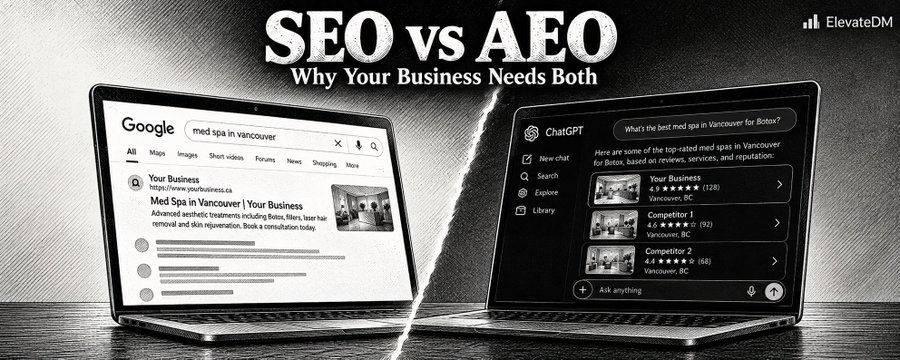
Google isn't the only place people search anymore. ChatGPT, Perplexity and AI Overviews now answer questions directly, and if your site isn't built for both, you're missing customers. Here's how to fix that.
First, what's the difference?
SEO (Search Engine Optimization) is about ranking your website in search results. Someone searches "med spa near me", sees a list of links, and clicks one.
AEO (Answer Engine Optimization) is about getting your business mentioned in the answer itself. Someone asks ChatGPT "what's the best med spa in Vancouver for Botox", and the AI responds with a short answer and a few recommendations.
With SEO, you're competing for a click. With AEO, you're competing to be named.
Why this matters now
More people are skipping the list of links and asking AI tools directly. Google itself now shows AI Overviews at the top of many searches, which means some people get their answer without scrolling.
That doesn't make SEO obsolete. It means the way people find businesses has split into two paths, and you want to show up on both.
Why you still need SEO
AI tools don't invent their knowledge from nothing. They pull from websites, reviews, directories and other sources they consider trustworthy. Many of them lean on search results to decide what to reference.
A well-optimized site is the foundation. If search engines can't crawl and understand your site, AI tools will have a harder time doing it too.
SEO still drives:
- Local searches with high buying intent
- Google Maps and Business Profile visibility
- Long-term traffic you don't pay for per click
- Stronger landing pages for your ads
Why you need AEO on top of it
AEO focuses on being the clearest, most quotable answer. AI tools favour content that directly answers a question, is easy to parse, and comes from a source that appears credible across the web.
A page can rank decently in Google and still get passed over by AI if the information is vague, buried or inconsistent.
How to get noticed by AI
- Answer real questions clearly. Write content around the questions customers actually ask. Put the direct answer near the top, then explain.
- Add FAQ sections. Short, specific question and answer pairs are easy for AI tools to pull from.
- Use structured data (schema). Schema markup tells search engines and AI exactly what your business is, where it's located, what services you offer, and more.
- Keep your business info consistent everywhere. Your name, address, phone and services should match across your website, Google Business Profile, directories and social profiles.
- Build reviews and mentions. AI tools look at what others say about you. Reviews, local press and directory listings all add credibility.
- Be specific about who you serve and where. "Laser hair removal in Kitsilano, Vancouver" is easier for AI to match to a question than "beauty treatments".
- Make your site technically clean. Fast load times, mobile-friendly pages and a clear heading structure help both search engines and AI read your content.
- Show expertise. Name your practitioners, list qualifications, explain your process. Content that shows real experience is more likely to be trusted.
SEO and AEO work together
Think of SEO as making sure you're in the library, and AEO as making sure you're the book the librarian recommends. You need both.
Businesses that focus only on traditional rankings may lose ground as AI search grows. Businesses that chase AI mentions without a solid site underneath won't have much for those tools to work with.
See where your site stands
You can check how your site performs for both search engines and AI visibility for free at elevatedm.ca.
For a deeper look, seo.elevatedm.ca runs a full site audit and asks ChatGPT, Claude and Gemini the questions your customers ask, so you can see whether you get named and who gets named instead.
Run a check, see what's missing, and start with the fixes that matter most.
Run the check on your own site
A site audit and an AI visibility check on your own site, with the fixes in order of impact.
Start my free trial